The Equation of Time Explained for Sundial Owners
A sundial is often called the oldest clock, but it keeps a different kind of time from the one on your wrist. On some days the two agree closely; on others the dial is several minutes ahead or behind. That seasonal disagreement is not a fault in the instrument. It is the equation of time, and it is the one correction every dial owner should understand.
Apparent Noon and Mean Noon
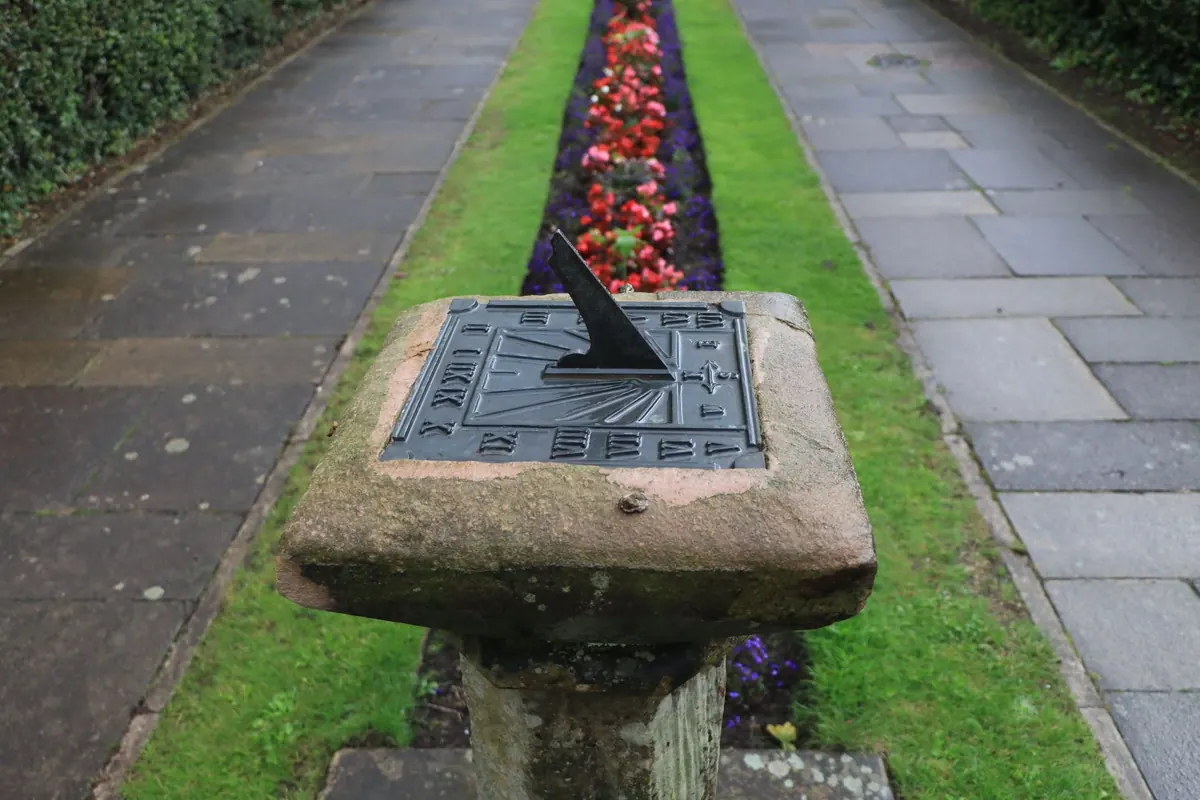
A sundial reads apparent solar time. Its noon is the moment the Sun crosses your local meridian—the imaginary line running from due north to due south through your location. At that instant the Sun is at its highest point for the day, and the shadow on a correctly aligned dial marks 12:00. This is real, observable solar time, not a convention invented by clockmakers.
Mean solar time is different. It is based on the average length of a solar day, divided into 24 equal hours. Clocks and watches keep mean time because a uniform hour is easier to manufacture and live by. Mean solar time is not the same as civil time: it has no time-zone offset and no daylight-saving adjustment. It is simply the steady average that a clock would show if the Sun moved at a constant rate all year.
The equation of time is the difference between these two systems: equation of time = apparent solar time - mean solar time. When the number is positive, the dial is ahead of mean time. When it is negative, the dial is behind. The correction is usually small—rarely more than about a quarter of an hour—but it is large enough to notice, and it changes through the year in a regular pattern.
Why the Sun Is Not a Steady Clock
Two facts about Earth's motion cause the difference. First, Earth's axis is tilted by about 23.4 degrees. As we orbit the Sun, the Sun's apparent path across the sky shifts north and south, and its daily motion is not projected evenly onto the celestial equator. Second, Earth's orbit is elliptical, not circular. Our planet moves slightly faster when it is nearer the Sun in early January and slower when it is farther away in early July.
The tilt produces one part of the equation of time; the elliptical orbit produces another. Neither is large on its own, but they combine into a curve with two maxima and two minima. The result is a gentle but irregular wave: the dial gains on mean time, loses it, gains again, and loses again. The November peak is the largest, which is why early November is the classic time to notice a sundial running fast.
The Year in a Handful of Dates
You do not need a computer to use the equation of time. A few dates and a rough graph will handle most garden-dial readings. The values below are approximate; a printed table for your year will be more precise. Read them as landmarks, not as fixed law.
- February 11: about -14 minutes. The dial is slow; at mean noon it reads roughly 11:46.
- April 15: near zero.
- May 14: about +4 minutes. The dial is fast.
- June 13: near zero.
- July 26: about -6 or -7 minutes. The dial is slow again.
- September 1: near zero.
- November 3: about +16 minutes. The dial is fast; at mean noon it reads roughly 12:16.
- December 25: near zero.
Notice the pattern: four zero crossings, two fast periods and two slow periods, with agreement occurring only briefly between them. The curve is not a random wobble; it repeats each year, so once you know where you are in the cycle you can correct a reading with confidence.
Applying the Correction to Your Dial
The sign of the equation of time tells you which way to move. If the dial is fast, subtract the correction from the dial reading to get mean solar time. If the dial is slow, add the correction to the dial reading. The same rule works in reverse when you want to predict what the dial should show at a given mean time.
Suppose it is November 3 and the equation of time is about +16 minutes. Your dial reads 1:00 p.m., but mean solar time is only about 12:44. If a clock keeping mean time shows 12:00, a correctly set dial should show about 12:16. On February 11, with the equation at about -14 minutes, the dial lags behind: at mean noon it reads roughly 11:46, and you must add about 14 minutes to the dial to recover mean time.
- Read the sundial carefully to the nearest minute.
- Look up the equation of time for that date, or estimate from your annual graph.
- If the value is positive, subtract it from the dial reading; if negative, add it.
- Record the result as mean solar time, then convert to civil time if you need a clock reading.
A useful rule of thumb: the dial is a truthful reporter of the Sun, not a faulty clock. Correct the report, and the instrument becomes far more useful.
From Mean Solar Time to Clock Time
Mean solar time is still not the time shown on a wristwatch. Civil clocks are set to a standard time zone, and they may also be shifted by daylight saving. To move from mean solar time to civil time, you need your longitude and the standard meridian of your time zone. Each degree of longitude equals four minutes of time. If you are east of your zone's standard meridian, local mean time is ahead of zone time; if you are west, it is behind.
For example, if your local mean solar time is 12:00 and your longitude is 3 degrees west of the standard meridian, zone time is about 12 minutes ahead—roughly 12:12 before any daylight-saving adjustment. Add an hour in summer if daylight saving is in force. This sounds fussy, but it explains why a dial that agrees with the equation of time may still disagree with the kitchen clock.
A Simple Routine for Dial Owners
You can make a useful record with very little equipment. Note the date, the dial reading, and the correction you applied. Over a year, that log becomes a personal check on both the dial and the table.
- Check alignment first: the gnomon must point to the celestial pole, and the dial must be level.
- Use the same reading point: read the shadow edge consistently rather than the centre of the shadow.
- Keep a correction card: a small card with the eight landmark dates above is enough for casual use.
- Separate the corrections: apply the equation of time, then longitude, then daylight saving, in that order.
Once you are used to it, the equation of time stops looking like an error and becomes part of the dial's character. It links the instrument to the seasons, to the tilt of the Earth, and to the slow elliptical journey that makes the Sun seem, for a few weeks each year, either early or late.
Photo: ysnapshotjournal / Pexels

You Might Also Like
At the winter solstice a sundial's shadow stretches two or three times the gnomon's height. Here is how to plan, expose, compose and protect camera and dial in the cold.
A hands-on family guide to the spring equinox: plant a stick, track its shadow, measure it at noon, and find true north with chalk and a child's height.