Reading Historic Wall Sundials in Italy: Mottoes, Symbols, and Solar Heritage
A wall sundial rarely announces itself. You notice one while waiting for a bus in a Veneto village, or glancing up from a table outside a Friulian osteria, or walking the lanes of a South Tyrolean hamlet where half the whitewashed facades carry their own halo of numerals. A faded fan of lines, a rusty iron rod, a band of Latin beneath the eaves — then the sun shifts, the shadow slides, and the wall turns out to be a clock. Italy has thousands of these dials, from the great meridians cut into cathedral floors to humble farmhouse pieces repainted by a grandson. Learning to read them changes a walk: facades stop being decoration and become instruments, and often small acts of devotion, vanity and wit.
What You Are Actually Looking At
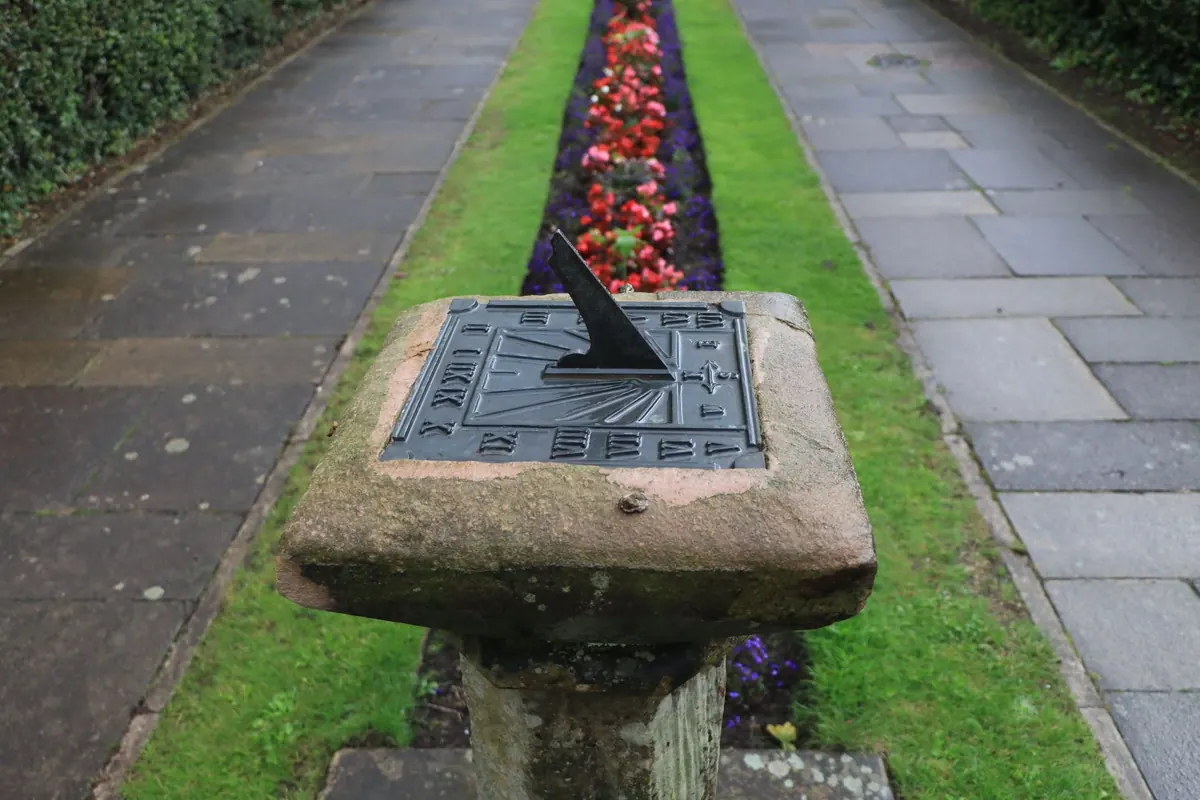
Almost every painted dial follows the same logic. A metal rod — the gnomon — projects from the wall at an angle, and its shadow falls across a traced grid. The angle matters: the rod must point at the celestial pole, which is why it leans away from the wall at roughly the latitude of the place, and why a dial moved from Bergamo to Palermo will never keep good time.
The lines radiating from the rod's base are the hour lines. The curves crossing them are declination lines: a hyperbola for the winter solstice, another for the summer solstice, and a straight line between them for the equinoxes. On rural dials these are often decorated with the signs of the zodiac, so the wall tracks not just the hour but the season. Somewhere near the bottom you will usually find a small painted panel with a date and initials — the year of painting, the names of the owners, sometimes the painter's signature. That cartouche is the first thing to photograph; it dates the dial and often identifies the workshop.
Which Hours Are These?
This is where modern readers stumble. Older Italian dials frequently use ore italiane, counted one to twenty-four from sunset. The first hour after sunset was 1, the following noon roughly 18 or 19 depending on the season, and the sequence ended where it began. It is an elegant system for a society that measured its evenings by darkness, and it looks baffling on a wall at midday.
Many dials also carry ore francesi, the double-twelve system we still use, and occasionally ore babilonesi, counted from sunrise. In religious settings you may find a line marked AVE MARIA — the hour of the evening bell, which structured the working day more firmly than any clock. And nearly all of them show true solar time, not the time on your phone. Solar noon and clock noon can differ by a quarter of an hour or considerably more depending on where you stand within the Central European time zone, and the equation of time adds up to a further difference across the year. A dial reading a few minutes "wrong" is usually doing exactly what it was built to do.
Mottoes: Latin in a Few Words
The inscription band beneath the dial is where the owner's character shows. Some are pious, some stoic, some quietly funny. A handful recur across the peninsula:
- Horas non numero nisi serenas — "I count only the serene hours." The most common of all, especially in the Veneto; often paired with a small sun.
- Sine sole sileo — "Without the sun I am silent." A gentle reminder that a cloudy day means nothing to read.
- Omnes vulnerant, ultima necat — "All hours wound, the last kills." Stern, ancient, and popular on alpine farmhouses.
- Festina lente — "Make haste slowly."
- Respice finem — "Keep the end in view."
- Umbra sumus — "We are shadow." Brief, and hard to improve on.
Read the inscription before you look at the hours. It tells you who commissioned the dial: a parish priest, a returning emigrant, a schoolmaster, a farmer with a taste for Horace.
Sun, Cross, and Skull
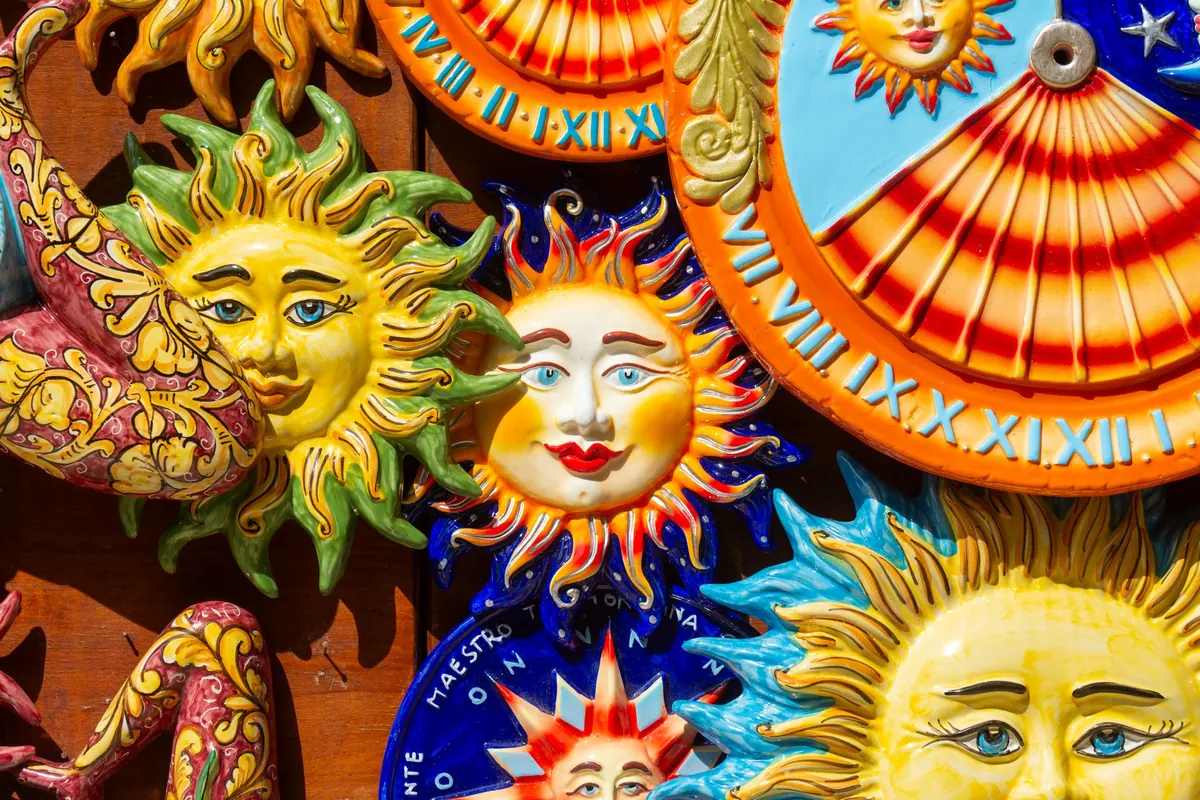
The imagery is rarely random. At the top of the dial, a radiant sun with a face is the standard motif, sometimes alternating straight and wavy rays to suggest light and heat. Above it you will often find a cross, a dove, or the IHS monogram — a reminder that time belongs to God before it belongs to the household. Local identity creeps in too: the Lion of Saint Mark on Venetian territory, the Florentine lily in Tuscany, the Tyrolean eagle north of Trento.
Below the dial the mood changes. Skulls, hourglasses with running sand, scythes and extinguished candles appear on dials from the seventeenth century onward — a memento mori in miniature, painted where the farmer would see it every morning. On church meridians the programme is grander: the long brass line across the floor, the hole in the roof casting a disc of light, the zodiac and the solstice marks, all designed so that the date of Easter could be checked against the sky.
Regional Traditions, North to South
Trentino-Alto Adige holds the densest concentration of painted dials in Italy. Look for them on farmhouses and inns, framed in a painted border, with the owner's name and a motto in German or Latin. Many were renewed in the twentieth century by travelling painters, and local restorers still repaint them in the traditional palette of ochre, iron red and blue.
The Veneto and Friuli come a close second, and here the dials are often pure decoration with a moral attached: osterie, villas, and village houses carrying elaborate mottoes and a sun with a curling smile. In Tuscany the monumental tradition dominates — the meridian lines of Santa Maria Novella in Florence and the great astronomical instruments of Bologna and Rome belong to the same culture of precise solar observation, though executed at a very different scale.
Alpine Piedmont, Lombardy and Valle d'Aosta favour compact dials on stone farmhouses; Umbria, the Marche and Abruzzo preserve hundreds on rural churches and rectories, often the only painted ornament left on the facade. In the south, dials are rarer but rewarding, and Sicily has a scattering of fine eighteenth-century examples on palazzi and convents.
Reading One in the Field
If you want to do more than take a photograph, work through this in order:
- Find the gnomon or its socket. A missing rod is common; the base and its angle still tell you the dial's purpose.
- Identify the hour system from the numerals and the layout — 24 hours in sequence suggests ore italiane.
- Check the sun's position. Solar noon is when the shadow lies on the vertical noon line; compare it with your watch to see the local offset.
- Read the cartouche for a date, initials and painter.
- Photograph the motto band straight on, in early or late light, so the lettering is legible.
- Ask at the parish or the comune. Local archives often hold the commission, and sacristans know more than any plaque.
A word on manners: many dials sit on private houses. Admire from the street, do not lean over gates, and never touch painted plaster — a fingertip does more damage than a decade of rain. If a dial is fading, tell the local Pro Loco or heritage association rather than attempting anything yourself. Restoration of these surfaces needs a conservator, and the value of a dial lies as much in its handwriting of wear as in its colours.
Photo: Jan van der Wolf / Pexels
You Might Also Like
At the winter solstice a sundial's shadow stretches two or three times the gnomon's height. Here is how to plan, expose, compose and protect camera and dial in the cold.
A hands-on family guide to the spring equinox: plant a stick, track its shadow, measure it at noon, and find true north with chalk and a child's height.