How to Read a Horizontal Sundial: A Beginner's Guide to Shadow, Gnomon, and Hour Lines
A horizontal sundial looks guileless: a flat plate, a raised wedge of metal, a fan of lines and Roman numerals. Then you stand in front of it, the shadow lands somewhere between two marks, and your watch disagrees by twenty minutes. Nothing is broken. A horizontal dial tells a different kind of time than the one on your wrist, and once you know which part of the shadow to read, the whole instrument becomes obvious in about a minute.
It helps to think of the dial as a solar instrument first and a clock second. It is not measuring hours as your watch measures them; it is showing where the sun is in the sky, projected onto a level surface. That single idea explains most of the confusion a beginner feels, including the odd spacing of the lines and the stubborn gap between dial time and wristwatch time.
The Parts That Matter
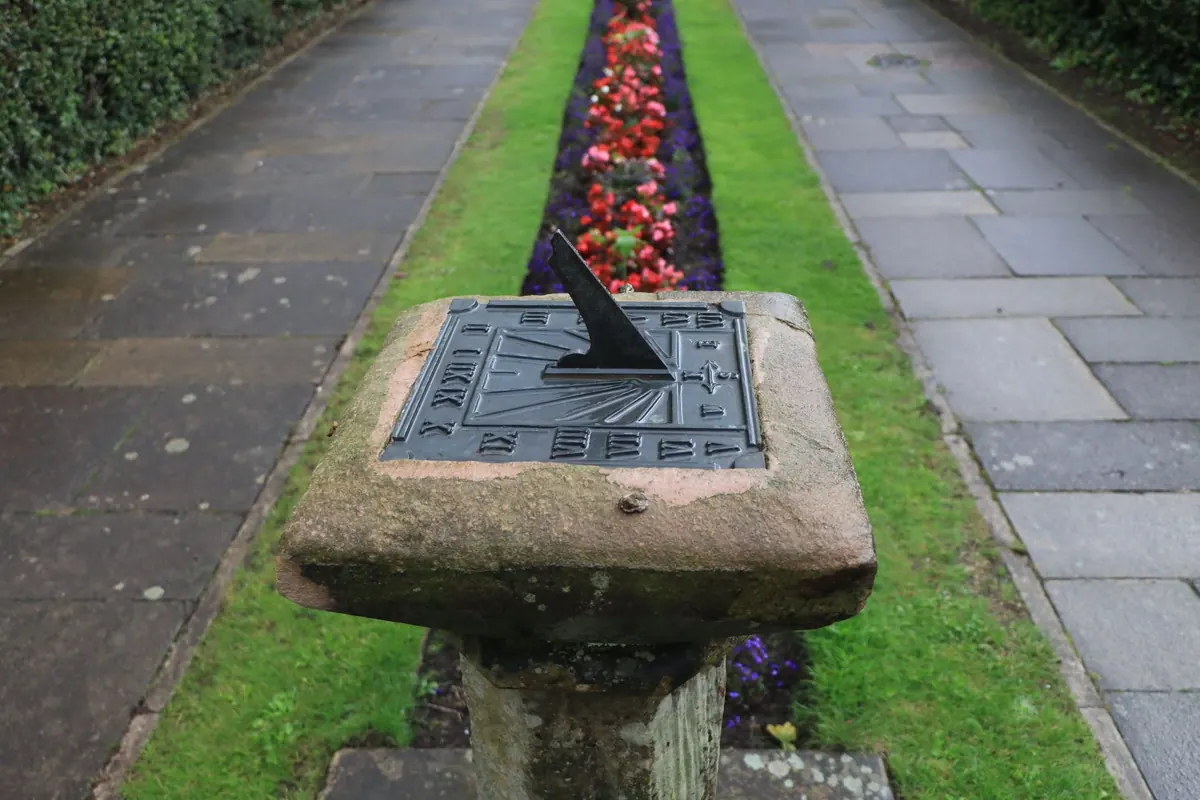
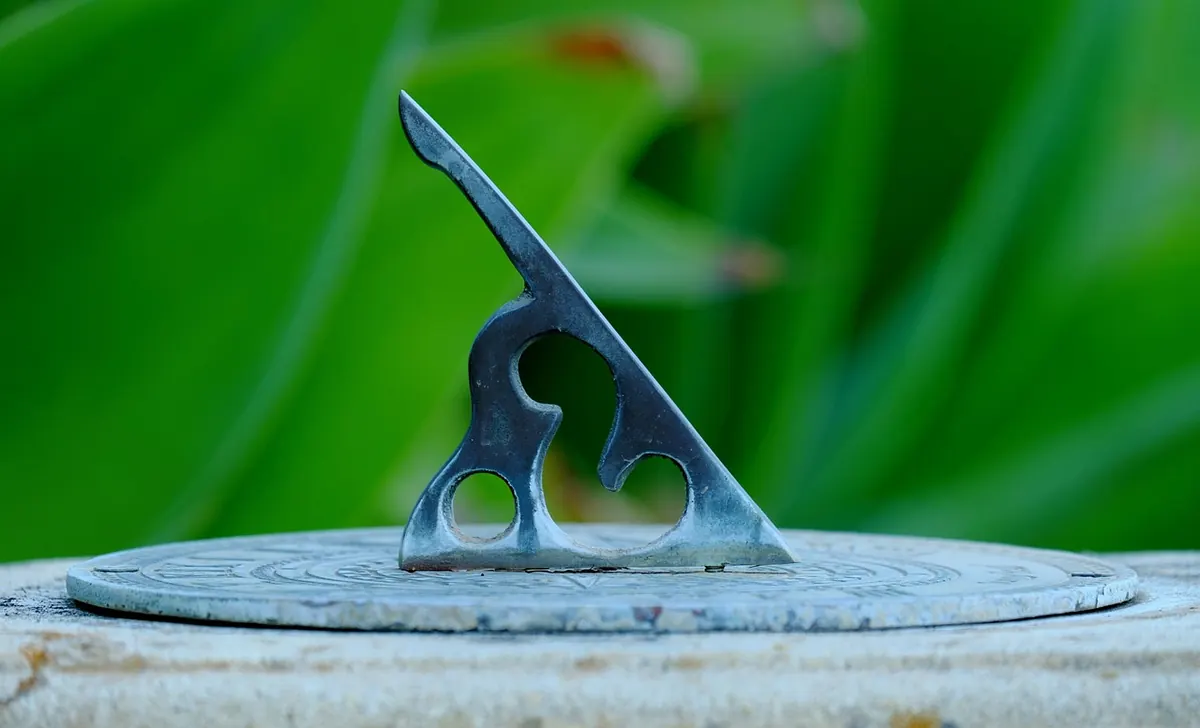
Every horizontal dial, whether it is a brass garden ornament or a carved stone plate in a walled courtyard, has four working parts. The dial plate is the horizontal surface, levelled so it sits parallel to the ground. The gnomon is the upright wedge whose sloping edge points at the celestial pole. The hour lines radiate across the plate, marked with Roman numerals from the early morning hours through XII and on to the evening. And the noon line — often slightly longer than the rest, or cut as a groove or a notch at the base of the gnomon — marks the meridian.
The plate itself matters more than it looks. If a garden dial is a degree or two off level, the shadow may still fall near the right numeral, so the error is easy to miss. But a tilted plate throws the shadow slightly away from the engraved line, and the reading drifts with the seasons. On any dial you intend to use seriously, check the plate with a spirit level and check that the noon line points truly north or south, depending on hemisphere.
Many dials add decoration: a motto, a compass rose, a date scale, initials. Ignore all of it on your first reading. The shadow only cares about the gnomon and the lines.
The Style Angle and Latitude
The sloping top edge of the gnomon has its own name: the style. It is the part that does the real work, and its angle is not arbitrary. The style is set to match the latitude of the site, so a dial made for London — about 51.5 degrees north — will not read correctly in New York, at about 40.7 degrees north, and a dial made for Sydney will be laid out in mirror image for the southern hemisphere. In the northern hemisphere the style rises towards the north celestial pole; in the southern hemisphere it points towards the south celestial pole. This is why a mass-produced dial bought in one country may look charming in another and still read poorly.
Which Part of the Shadow to Read
The gnomon casts more shadow than you need. Its triangular body throws a broad band of darkness, and the two edges of that band are not equally useful. The reading edge is the shadow of the style: the straight, sloping top edge of the gnomon, the one angled to match the latitude of the site. That edge is a line, and its shadow is a thin, sharp line running across the plate.
Beginners often try to read the middle of the whole shadow instead. On a well-made dial this gives roughly the same answer, but the proper method is cleaner: find the edge of the shadow that corresponds to the style and follow it to the hour lines. In practice the shadow is slightly soft, so use the centre of that shadow edge rather than its outer blur. On a bright day with a crisp shadow, you can judge this within a hair.
Read the edge, not the bulk. The style is the line; the rest of the gnomon is just furniture.
On a very broad gnomon, the correct shadow edge may be the one that begins at the style’s tip and continues across the plate. If you cannot tell which edge is which, move your eye until it lines up with the sloping top edge; the shadow that continues that line is the one to read.
Reading the Dial, Step by Step
- Keep your own shadow off the plate. Step to one side, or stand with the sun behind your shoulder.
- Locate the style edge — the straight, sloping top edge of the gnomon, not its vertical back.
- Trace its shadow line across the face until it meets the hour lines near the outer edge of the plate.
- Read the numeral the shadow points to. The numbers run in one continuous sequence from the early morning hours, through XII at the noon line, on to the evening — which is why IIII can appear twice on a full dial, once before noon and once after.
- Estimate between lines. If the shadow sits halfway between X and XI, the time is about half past ten. Better dials carry half-hour or quarter-hour marks, which makes this easy.
The dial cannot tell morning from afternoon. The same numeral appears on both sides of the noon line, and only the sky settles the question — one glance will tell you whether the sun is climbing or dropping.
A Note on Roman Numerals
Old dials often use IIII instead of IV for four, a convention that gives the numeral a pleasing symmetry with VIII on the opposite side of the plate. There is no zero, because a sundial has no midnight, and XII sits at the noon line rather than at the top of a clock face. On many dials the sequence runs continuously from the earliest hour shown to the latest, so the same numeral can appear on both sides of noon. Read the line, not the clock-face habit.
Why the Hour Lines Are Not Evenly Spaced
Look closely and you will notice something odd: the lines crowd together near the noon line and spread out towards the early and late hours. This is not a fault in the engraving. On a horizontal dial the hour lines are a projection of the sun's movement onto a flat surface, and that projection compresses the hours around midday while stretching them towards sunrise and sunset.
The practical consequence is worth remembering. Around eleven in the morning and one in the afternoon, an hour occupies only a small angle on the plate, so a millimetre of shadow movement stands for several minutes. Mid-morning and mid-afternoon, the lines sit further apart and reading by eye is easier and more accurate. If you want a precise reading, take it at ten or at three.
This is also why you should not measure a sundial with a ruler and expect equal spacing. The geometry is doing something clever: it is translating the sun's daily arc into a flat map of time. The spacing looks uneven because the map is uneven.
True Noon and the Noon Line
True noon, or solar noon, is the moment the sun crosses your local meridian and reaches its highest point. On the dial, that is when the style's shadow lies exactly along the noon line and the gnomon's shadow is at its shortest for the day. Watching for that moment is the most satisfying thing you can do with a sundial, and it needs no equipment beyond patience.
What true noon will not do is match your watch. Three offsets get in the way. The equation of time — the difference between apparent and mean solar time — shifts solar noon by up to about sixteen minutes either way across the year. Your daylight saving offset moves the clock forward an hour in summer. And your longitude relative to the standard meridian shifts solar noon by four minutes for every degree you sit east or west of it.
A small example makes the arithmetic concrete. Suppose a dial stands two degrees west of its time zone’s standard meridian. Solar noon there comes about eight minutes later than standard time would suggest. In summer, daylight saving adds another hour. Combined with the equation of time, that easily explains a twenty-minute disagreement between a correctly made dial and a wristwatch. The dial is not wrong; it is answering a different question.
You can use true noon as a check on the dial itself. At solar noon, the style’s shadow should lie on the noon line. If it does not, the dial may be rotated, the plate may be off level, or the gnomon may not be set for that latitude. Remember to apply the clock corrections before you blame the instrument.
Common Mistakes and How to Fix Them
- Reading the middle of the shadow. Follow the shadow of the style edge instead. The middle of the broad band is a rough approximation at best.
- Standing in the light. Your own shadow can fall across the plate and mimic a gnomon. Step aside and let the sun do the work.
- Forgetting the clock corrections. Equation of time, longitude, and daylight saving can add up to a very un-sundial-like gap.
- Expecting AM or PM. The dial repeats its numerals on either side of noon. Look at the sun’s position to decide which half of the day you are in.
- Ignoring level and alignment. A dial that is charming but crooked will read charmingly but wrongly. Check the plate and the noon line.
A Short Practice Routine
- Pick a clear morning. Choose a day when the shadow is crisp and the plate is in full sun.
- Read at known solar times. Take readings at ten, eleven, one, and three if the dial allows. These are easier
Photo: 1860100 / Pixabay

You Might Also Like
At the winter solstice a sundial's shadow stretches two or three times the gnomon's height. Here is how to plan, expose, compose and protect camera and dial in the cold.
A hands-on family guide to the spring equinox: plant a stick, track its shadow, measure it at noon, and find true north with chalk and a child's height.