Armillary vs Horizontal vs Vertical Sundials: Which Garden Style Fits Your Space?
Most people who fall for sundials fall for a picture: a stone plinth at the end of a lavender path, a bronze gnomon throwing a thin line of shade. Then they start looking properly and discover the picture comes in three quite different shapes — the flat horizontal plate, the upright vertical dial, and the open cage of rings called an armillary sphere. They look related. They behave very differently once they're standing in a garden.
The choice is less about which type is best and more about which fits your space, your reading habits, and how much adjusting you want to do at installation. Here is how the three compare where it actually matters.
Three dials, three ways of catching the sun
Horizontal: the flat plate
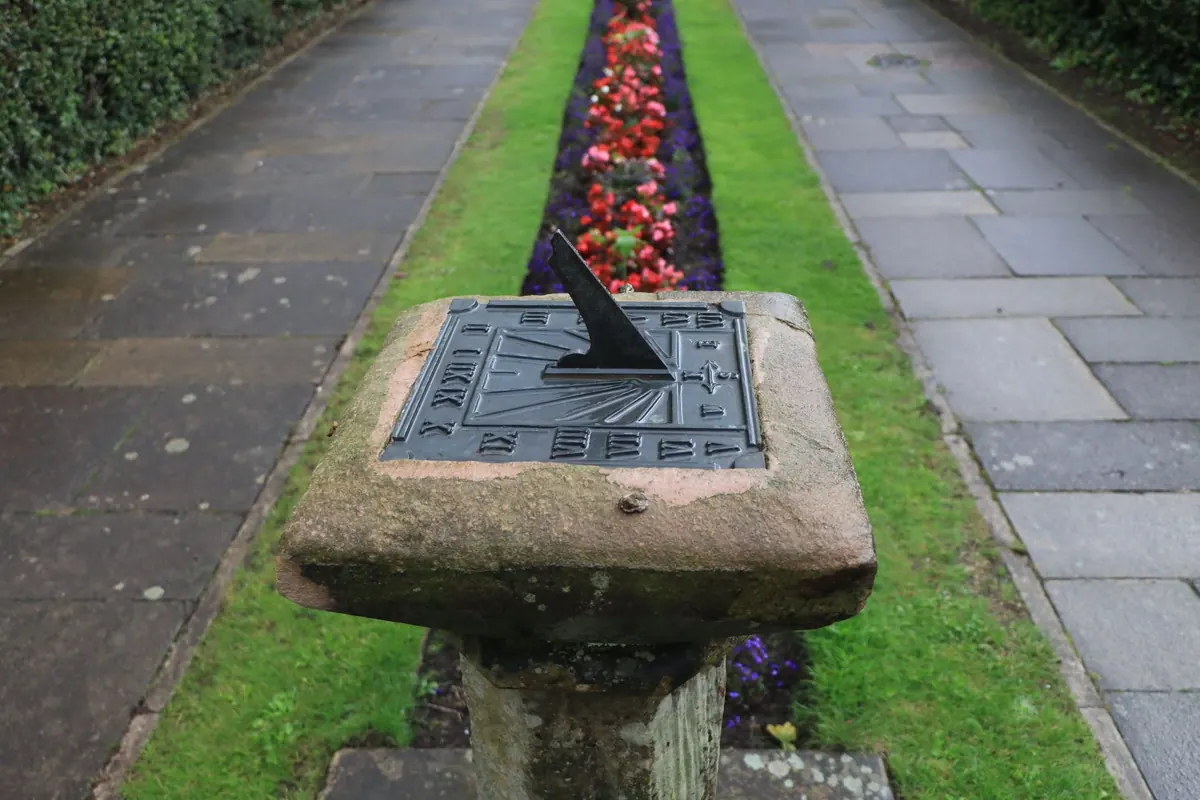
A horizontal dial lies level on a pedestal, wall coping, or stone plinth. Its gnomon — the angled fin at the centre — is set to your latitude, and the hour lines fan across the plate. It is the classic garden dial and the most forgiving to read from standing height.
Vertical: the dial that lives on a wall
Vertical dials mount flush against a wall. In the northern hemisphere the useful face is generally the south-facing one; in the southern hemisphere it is the north. The hour lines are drawn for that specific wall orientation, which is why two vertical dials on two different walls of the same house are not interchangeable.
Armillary: rings instead of a plate
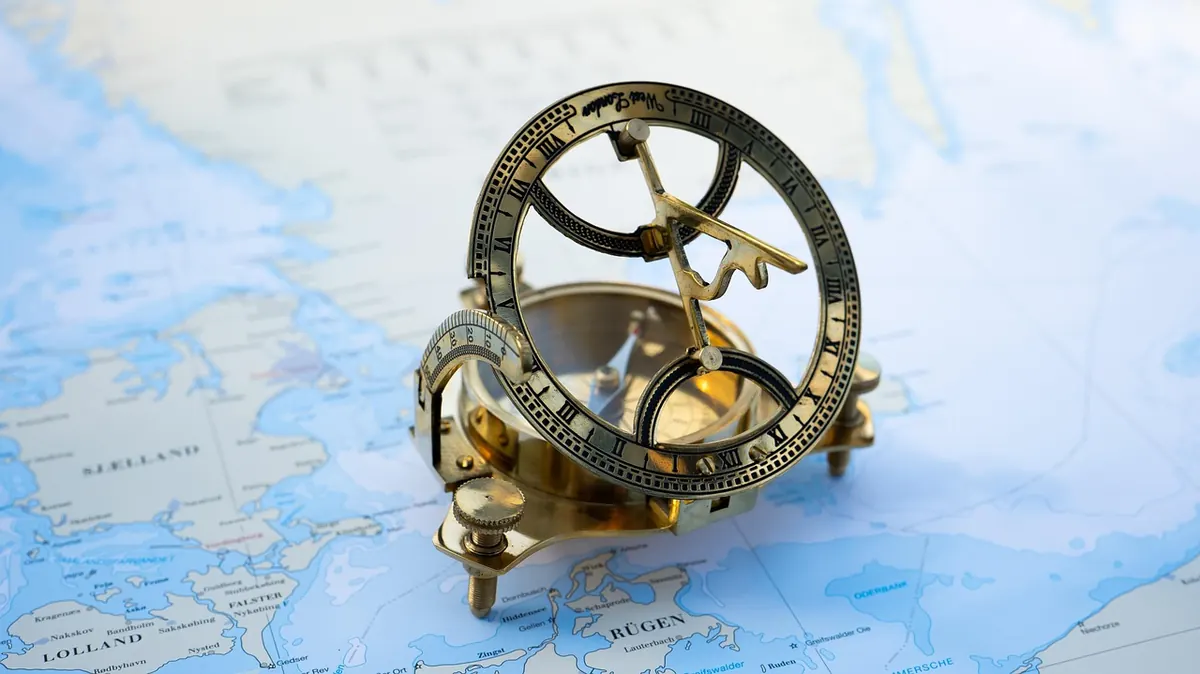
An armillary sphere uses intersecting rings to model the celestial sphere — equator, tropics, sometimes the ecliptic. The shadow of a central rod falls across an hour ring. It is the most sculptural of the three and, in many catalogues, the most likely to be sold as ornament first and instrument second.
Readability: what you actually see at four in the afternoon
Readability comes down to the time it takes to go from "where is the shadow" to "that's quarter past four."
Horizontal wins for most people. The plate sits at hip or chest height, the numerals face up, and you read it the way you'd read a plate on a table. If the dial will be somewhere children and guests wander up to, this is the safe choice. Ask for hour lines engraved deep enough to hold a shadow; shallow etching on polished metal can vanish in flat winter light.
Vertical is easy enough once you're standing square to the wall, but the dial is at eye level or above, and the angle is awkward on a tall facade. Low walls and gate piers make excellent hosts; a three-metre house wall above a flower bed is less friendly. Because a vertical dial is usually read at a glance from a path, large numerals and clear half-hour marks matter more than fine detail.
Armillary rewards patience. Some designs have hour bands wide enough to read from a couple of metres away; others are engraved so finely that you'll be leaning in with your hands behind your back. If you want a working dial rather than a sculpture, check for a numbered hour band and a gnomon rod that casts a clean shadow onto it. If you're choosing one mostly for the look, be honest about that — there is nothing wrong with a beautiful object that keeps time approximately.
Mounting: what your site has to provide
Mounting is where garden plans most often go wrong, so settle it before you fall in love with a design.
- Horizontal: needs a level, stable base — pedestal, plinth, wall coping, or a broad flat stone. The plate must be level in both directions, and the gnomon must point to true north rather than magnetic north. Small errors here produce a dial that is consistently a few minutes out.
- Vertical: needs a wall facing the right way and holding sun for most of the day. The dial is cut for that wall's orientation, so measure before ordering: one drawn for a wall facing due south will misread on a wall that faces south-southeast.
- Armillary: usually needs the most clearance. The rings cast shadows on each other, so a sphere tucked against a hedge or under a tree canopy can be functionally useless. Give it open sky and a metre or two so you can walk around it.
One shared requirement: a clear horizon. A dial shaded by a building or a mature tree from two o'clock onward will only tell half a day's worth of time, however well made it is.
Accuracy: what each type can and cannot do
All three can read to within a few minutes when correctly made for your latitude, correctly aligned, and read with the correction for the equation of time — the difference between solar time and clock time, which shifts through the year and can reach roughly a quarter of an hour. Longitude matters too: dials are drawn for a reference meridian, and the further you sit east or west of it, the larger the offset.
Beyond that baseline, the differences are practical. A horizontal dial with a solid gnomon gives a crisp, unambiguous shadow line and is easy to check against a watch, so it is the simplest to fine-tune. A vertical dial is limited by its wall: the orientation must be known, and a wall that drifts even a few degrees off the intended bearing needs a dial drawn for that bearing or a correction applied. An armillary is the hardest to adjust, because the rings must be set for latitude and the whole assembly aligned — and many garden versions have fixed rings that cannot be adjusted at all.
A sensible routine for any of them: install it, then compare it with a clock at several times of day over a few weeks. If it is consistently out by the same amount, the alignment needs attention. If the error swings with the season, you are simply watching the equation of time do its normal work.
Aesthetics: matching the dial to the garden
Style is personal, but the physical logic is fairly consistent.
Horizontal dials suit formal and cottage gardens alike. They read as furniture — something to walk up to, set a cup of coffee beside, rest a hand on. On a pedestal where two paths cross, or as a centrepiece in a gravel or herb bed, they hold a space without shouting.
Vertical dials are architectural. They belong on the gable of a stone house, a garden wall, a gate pier, or the sunny face of a shed. They are the best choice for narrow plots and courtyard gardens, where a pedestal would eat the walking room, and you never have to worry about a base sinking or shifting.
Armillary spheres are sculpture first. They work best where they can be seen in silhouette — against sky, at the end of an axis, beside water — and where you can circle them. In a tightly planted border they tend to vanish into the foliage. Brass or bronze gives a warm, classical look; painted steel or dark iron reads more contemporary and asks less polishing.
A short way to decide
- Measure your sun. Note where the garden is unshaded between roughly nine in the morning and four in the afternoon. That is your candidate zone.
- Check your base. Do you have a level spot for a plinth, or a suitable wall? That single answer often settles the type.
- Decide how you'll read it. Standing at chest height, glancing from a path, or walking around an object — pick whichever matches your daily route.
- Confirm the dial is made for your latitude and, for vertical dials, for your wall's orientation.
- Then choose the look you actually want. Within those constraints, style costs you nothing.
Placing it well
Whichever type you choose, three small habits will turn it from ornament into something you use. Site it so you can reach it without stepping through a border. Make sure the shadow falls on the markings rather than off the edge at the hours you're most likely to look. And accept the friendly imprecision of solar time — a garden dial is a way of noticing the season, not a replacement for your phone.
If your space gives you a level patch and open sky, a horizontal dial will serve you best and forgive the most. If you have a good wall and a narrow path, go vertical. If you want something to look at as much as something to read, an armillary earns its place — just give it room, and check that it can tell the time before you build the bed around it.
Photo: Birgit Böllinger / Pexels

You Might Also Like
At the winter solstice a sundial's shadow stretches two or three times the gnomon's height. Here is how to plan, expose, compose and protect camera and dial in the cold.
A hands-on family guide to the spring equinox: plant a stick, track its shadow, measure it at noon, and find true north with chalk and a child's height.